Chapter 13
Written by Mateen A. Khan, NJ
A version of this article was first published in Al-Madania Magazine.
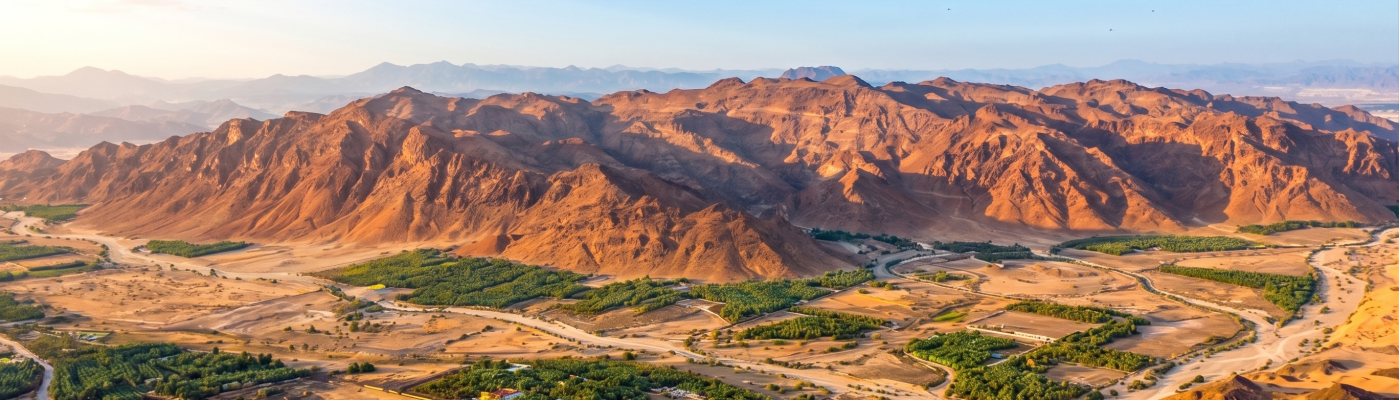
Mount Uḥud rests just north of al-Masjid al-Nabawī. Some 700 million years ago, molten magma cooled beneath the Earth’s surface, and the mountain arose from it. To see it is to behold an expansive and impressive formation, wide-shouldered as if to hold up the sky and firm-footed as if to hold down the land. Since then, it has stood guard over the area, long before people, property, and the Prophet ﷺ arrived there. Allah created it majestic and firmly rooted in red-pink rhyolite and light gray dacite, which give it strength.
It’s hard not to admire a formation that waited inconceivable eons for its beloved. How many lonely sunsets had it waited in anticipation of its beloved, in an area uninhabited for most of its existence? How long did it look over a patch of Earth from which the Messenger was created, knowing he would return there? The Prophet ﷺ said of it: “Uḥud is a mountain which loves us, and we love it.”
Provoking the Populace
Previously, the Battle of Badr saw the death of many of the Qurayshī nobility, and the remnants of that army retreated back to Makkah, dejected. As they trickled into the town, the poets, the propagandists of that time, whipped up emotions, acting as the agents of psychological warfare and political agitation.
One of them, Abū ʿAzzah al-Jumaḥī, was captured at Badr but gained the Prophet’s clemency after mentioning his own poverty and dependent daughters. One imagines a thin, greying man begging the very person he swore to kill. And a Prophet ever-trusting, rooted in ḥusn al-ẓann (a good opinion of others), was true to his words when he said: “The believer is unsuspecting and magnanimous.”
He ﷺ, a mercy to his enemies, released him without ransom on the condition that he would never raise a hand or a word against the Muslims. Unfortunately for him, he was swayed by one of the Qurayshī leaders, Ṣafwān ibn Umayyah, to begin composing lines. How could the noblest tribe of Makkans let such a lucky defeat by ragtag “rebels” go unpunished? Thus, tribalism, the precursor to nationalism, demanded close-minded vengeance.
The proceeds of Abū Sufyān’s caravan were allotted for this cause, and fresh recruits were brought to the fore. The voices of Hind bint ʿUtbah and Jubayr ibn Muṭʿim stoked the Makkans, and separately, the two enticed Waḥshī, the skilled javelinist, to assassinate Sayyidunā Ḥamzah, the Prophet’s ﷺ devoted uncle.
The March to Uḥud
On a regrettable day in Shawwāl of 3 AH, the Makkan army set out, well-equipped and funded, with three thousand soldiers, including Hind along with many other women. They marched until they encamped outside of Madinah.
At first, the Prophet ﷺ took a defensive posture and waited in Madinah for their attack. Ibn Ubayy, a hypocrite but a leader to many, agreed with the Prophet ﷺ on this. A group, particularly among the youth and those who had missed Badr, wished to meet their enemies face-to-face and urged him to do so. The Prophet ﷺ was eventually swayed to put on his own armor, and they headed out towards Uḥud.
The Muslim army of 700 men stood with their backs against Uḥud, about three kilometers outside of Madinah, with 50 archers on a small, nearby mount. He instructed the former not to attack until the order was given, and the latter not to leave their stations under any circumstances.
Despite their victory at Badr, the Madinan community was still nascent. The Battle of Uḥud was another existential crisis. As the Prophet ﷺ set out, everyone, old and young, wanted to join. Samurah and Rāfiʿ were just teenagers, wanting nothing more than to stand by his side. Initially, the Prophet ﷺ felt for them, and the two were dismissed from joining, like many others. His mercy initially sent them back, but he later allowed them to join when they showed they could handle themselves, moved by their resounding sadness at the prospect of being left out.
The Sacrifices of the Companions
The battle soon started. Each group sent its finest to the forefront. Sayyidunā Ḥamzah, a staunch defender of the Prophet ﷺ, killed many Qurayshī leaders. However, Waḥshī stalked him from behind the formations. Jubayr promised him freedom and Hind riches in exchange for Ḥamzah’s life. He watched closely, without blinking, with steadied arms, until a window opened between them. His javelin hit its mark.
Ḥamzah’s body falling must have been like a shockwave through the Muslim lines, unsteadying their feet. However, the same javelin that gave Waḥshī his freedom from bondage gave Ḥamzah his freedom from the world’s hardship, the grave’s trials, and Jahannam’s fire. Later, Hind, still lacking prophetic morality and composure, mutilated his body further by cutting into him and attempting to eat his liver. This profoundly scarred the heart of the Prophet ﷺ.
Another of the hundreds of accounts that day was that of Sayyidunā Muṣʿab ibn ʿUmayr. Prior to Islam, he was born into a life of extravagance and was known for his opulent clothing. After meeting the Messenger ﷺ, he exchanged falsehood for truth, riches for poverty. That day, he was the standard-bearer for the Muslims. He fell in defense of the Prophet ﷺ. With a heavy heart, the Prophet ﷺ eulogized him: “I saw you in Makkah, and there was no one in it with a finer garment or a more handsome head of hair than you. Yet here you are, your head disheveled, wrapped in a simple cloak.”
Sayyidunā Khabbāb added, “Muṣʿab ibn ʿUmayr was martyred on the Day of Uḥud, and we found nothing to shroud him in except a burdah (a short woolen cloak). If we covered his head with it, his feet were exposed, and if we covered his feet, his head was exposed.”
A Costly Mistake
These are just two Companions among hundreds who fought so valiantly that the Qurayshīs broke and began running, men and women. Seeing this rout and thinking the war over, the archers abandoned their post, forgetting the Prophetic command, and joined the rest. The Muslims rejoiced prematurely and exposed a passage for attack by the disbelievers.
Like a dark storm, the disbelievers descended swiftly upon them. The Companions scattered. Through the tempest, a rumor spread of the Prophet’s demise. In actuality, he was injured, and the remaining Companions surrounded him. Abū ʿUbaydah, Abū Dujānah, Saʿd, Qatādah, Ṭalḥah, Ziyād, and ten others were martyred in the process as the disbelievers threw everything and everyone at him ﷺ.
During the most intense moments of the battle, Abū Dujānah stood before the Prophet ﷺ with his back facing the enemy. He absorbed scores of arrows into his own back, refusing to budge an inch out of fear that a single arrow might bypass him and strike the Prophet ﷺ. Similarly, Qatādah intentionally directed his face toward the enemy to bear the brunt of the arrows instead of the blessed face of the Prophet ﷺ. This act of devotion resulted in an arrow striking him with such force that his eye was dislodged from its socket. The Prophet ﷺ, in a profound moment of love and healing, miraculously restored the eye and supplicated for Qatādah’s beauty and handsomeness.
Each is a story of requited love, never to be forgotten in the annals of history. Finally, the Muslims planted their back feet and turned, as one soldier, to protect him ﷺ. Allah the Exalted strengthened them and routed the disbelievers once more.
Beyond the Battlefield
Beyond the clash of swords, there were at least two women in the fray. Sayyidah Fāṭimah, the Prophet’s daughter, rushed to her father’s side. She found his face profusely bleeding. One would rather their heart bleed than watch it flow from him. When her husband, Sayyidunā ʿAlī, was unable to stop the bleeding by washing it, she stepped in to tend to his injuries by applying ash from a burnt straw mat to pack the wound. She became calm only when the bleeding stopped.
Likewise, the Sīrah informs us of an unnamed female Companion who, despite the catastrophic loss of her father, husband, and brother that day, repeatedly demanded, “Tell me about the condition of Allah’s Messenger!”
In the Shade
The battle ended with losses on both sides. The archers’ mistake was costly. Seventy were martyred that day, mostly from the Anṣār. Yet, surviving an existential battle, defending the homeland, and protecting our beloved was indeed a win. The lesson was clear: success is only through unifying in obedience to the Messenger ﷺ.
The dust settled, the sun lowered, and the Muslims slowly rose. Standing over the shuhadāʾ, the Prophet ﷺ recited:
“Among the believers are men who have proven true to what they pledged to Allah. Some of them have fulfilled their pledge ˹with their lives˺, others are waiting ˹their turn˺. They have never changed ˹their commitment˺ in the least.” (Qur’an 33:23)
From himself, the Prophet ﷺ added, “Indeed, the Messenger of Allah bears witness that you are martyrs in the sight of Allah on the Day of Resurrection.”
And standing over all of this was Mount Uḥud. Another fourteen centuries have passed over it, and we gaze upon it today as the Prophet and his Companions did then. Now, no longer waiting for its beloved, the silent giant stands humbly before him, its shuhadāʾ, and those fortunate enough to reside in its shade.

