By Imam Numaan Cheema, Zubaida Foundation, Yardley, PA
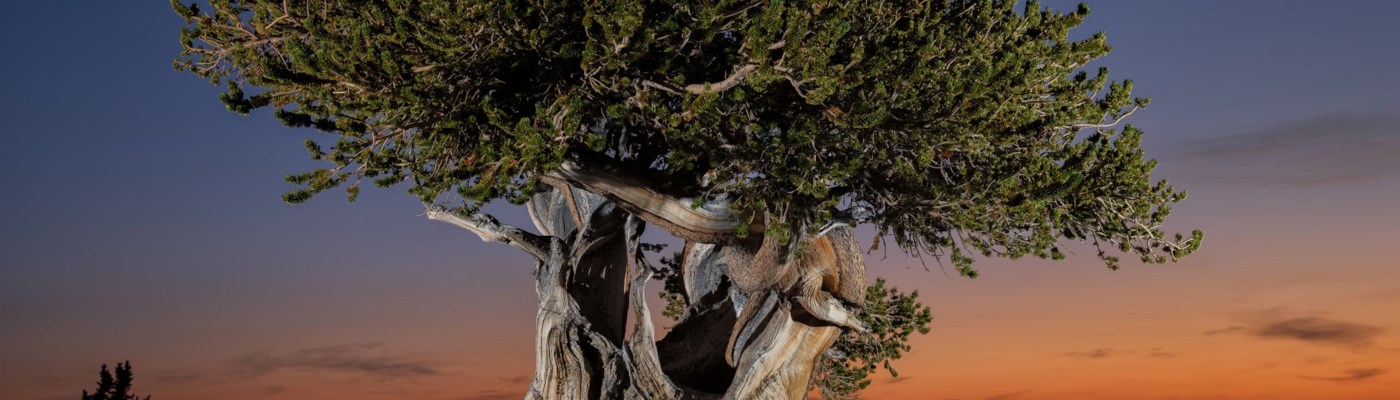
In the high, wind-scoured ranges of Nevada and Utah stand the Bristlecone Pines, trees older than the pyramids, Stonehenge, and every empire that once thought itself eternal. They grow where almost nothing else survives, in thin air and rocky soil beneath an unrelenting sun. Their growth is almost imperceptible, barely an inch in a century, yet it is this very slowness that allows them to outlast storms, droughts, and time itself.
On these ancient slopes, a phenomenon unfolds called strip-bark growth. Over the centuries, much of the trunk dies away until only a narrow ribbon of living bark remains, wrapping itself around one side of the tree. Through this small passage, life continues to move between the roots and the branches, quietly sustaining what should have long perished. When a section of bark no longer serves its purpose, the living strip pivots. It moves, redirects, and repositions itself toward the side that can still receive light and give life. It adapts with patience, feeding what little remains until it can survive another century.
The Qur’an calls us to contemplate creation not as background but as āyāt, signs of the Almighty:
“Indeed, in the creation of the heavens and the earth are signs for those who reflect.”
The Bristlecone Pine is one such sign, a sermon written in wood and wind. It teaches that divine favor is not measured in speed, noise, or quantity, but in steadfastness. What looks barren to the eye may, in the unseen, be deeply alive, sustained only by Allah’s mercy. It asks for no attention, no admiration, but only to remain true to its purpose. The Bristlecone grows not through abundance but through rootedness. It bends, adjusts, and learns to survive through its losses. It does not resist change; it moves with it, finding life in unlikely directions.
There is a quiet message in that for those who work in the path of Allah. We live in an age of constant motion, a culture that glorifies perceived productivity, visibility, and instant results. But sacred work does not move by the measures of this world. Prophetic work has always been slow work; patient, hidden, sustained by sincerity rather than spectacle. The strip-bark growth of the Bristlecone mirrors the journey of every dāʿī, teacher, and believer who continues to nurture life in the path of Allah even when stripped of help, comfort, or recognition. When one avenue closes, they turn to another. When strength fades, they lean upon what remains alive within them. Their work pivots not from desperation, but from trust.
The essence of the Bristlecone’s survival is not in stillness, but in quiet redirection. It does not cling to what has died, nor does it announce its movement; it simply turns toward where life still flows. So too is the work of dīn. It lives through those who continue their efforts in silence when recognition fades, who tend to what remains rather than mourn what is lost. When a public effort falters, they keep teaching one soul at a time. When the crowds thin, they nurture the few who still seek. This is not retreat, but sincerity in its purest form as quiet work does not shrink the mission; it purifies it. For daʿwah has never been sustained by scale, but by the unseen sincerity that Allah alone witnesses.
This relentless outward endurance, however, is not sustained by movement alone; it must be anchored in unseen support. The Bristlecone’s longevity is secured by its deep, widespread root system, which is the silent foundation that nourishes the narrow, living bark. Similarly, the work of the believer (the outreach, teaching, and service) must be sustained by the quiet, unseen roots of personal prayer, reflection, and study. This inward, foundational work is the source of the barakah and strength; it is the unseen nourishment that allows the visible strip of effort to survive the harshest spiritual droughts and storms.
True endurance in the work of Allah means moving with the rhythm of time, not as defined by trends, but by what is defined by the Divine. Slow is not stagnant, for growth that is meant to last millennia cannot be rushed. Depth always outlives reach, and what is built deeply endures beyond what is built broadly. Scarcity is no barrier, for Allah breathes barakah into the little that is offered with sincerity. Much of what sustains life remains unseen, like roots that nourish silently beneath the soil. And so the believer learns to move like the Bristlecone, to adjust and adapt, to continue when others have stopped, trusting that our duty is to plant while the unfolding belongs to Allah.
The Bristlecone Pine does not hurry; it endures. And in its endurance lies the secret of every worker of dīn: to keep growing with what little remains, to pivot where life still flows, and to stay alive through that thin strip of sincerity that connects the heart to its Source. This wisdom is a constant call to reflection for every believer: Where is the living strip of sincerity in my work today,and where must I pivot to ensure its survival for another generation?
“Surely, in that there are signs for a people who believe”
 Enter the Sunnah